The Science Behind ASPIRA: What the Published Research Found
Lior HendlerMost breath products mask odor for a few minutes. ASPIRA takes a different approach, and that approach has been tested in published, peer-reviewed research — including a randomized controlled trial in 40 people, measured a full day after use. Here is what the studies actually did, what they found, and what they don't show.
What is ASPIRA?
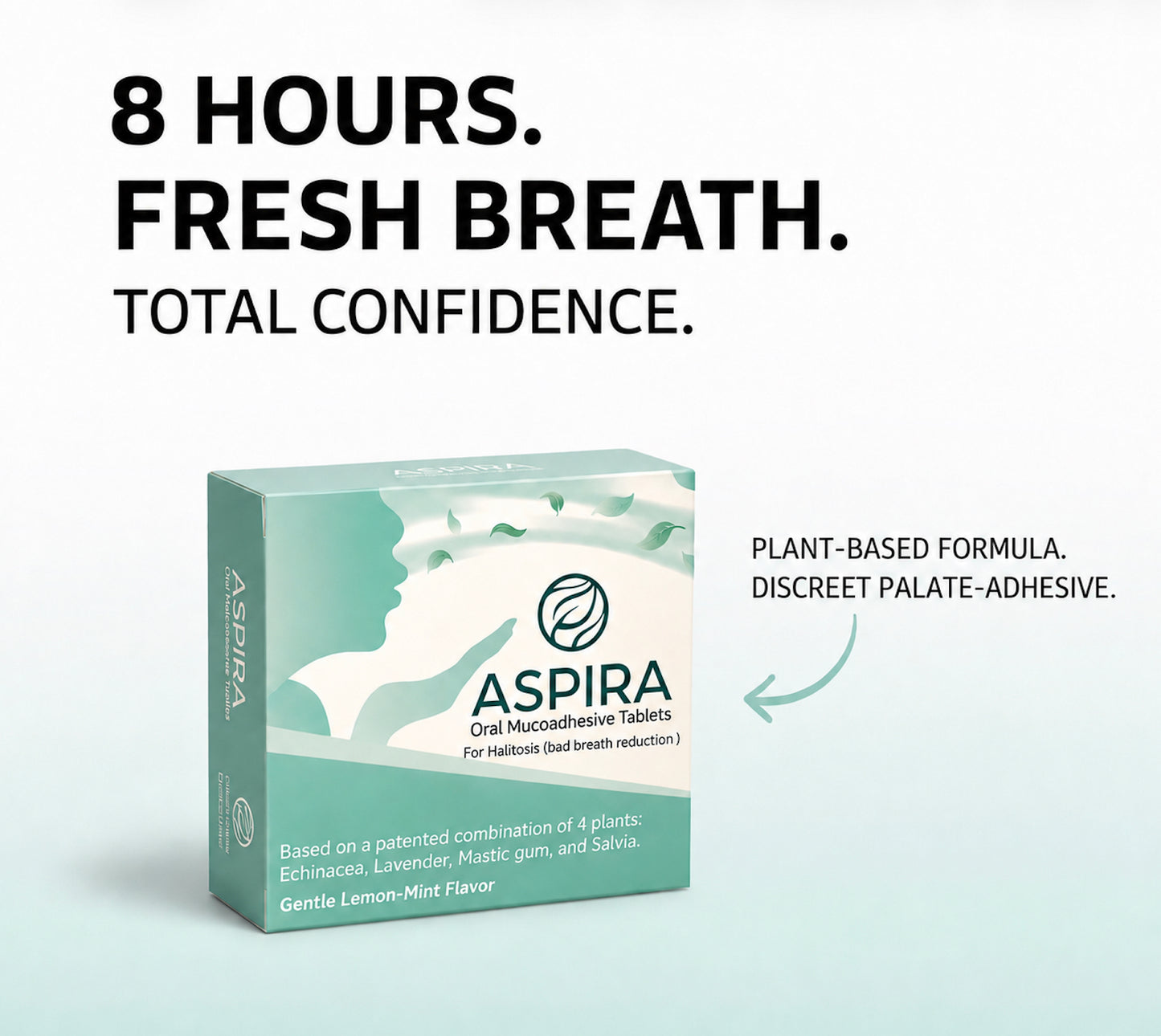
ASPIRA is a plant-based mucoadhesive tablet for fresh breath. It contains a patented formulation of four botanicals — Echinacea, Lavender, Mastic gum and Sage (Salvia) — in a tablet that adheres to the inside of the cheek or the roof of the mouth and dissolves slowly, rather than being chewed or swallowed. It is a cosmetic oral-care product, made in Israel, and protected under US patent 9,480,641 B2.
Why does bad breath come back after brushing?
Because brushing doesn't remove what causes it for long. Bacteria in the mouth — mostly on the back of the tongue and below the gumline — break down proteins in saliva, and the by-products include volatile sulfur compounds: hydrogen sulfide, methyl mercaptan and dimethyl sulfide. Those gases are what people actually smell.
Those bacteria repopulate within hours. So anything that works by covering odor, or by rinsing the mouth once, stops working as soon as its own effect fades. A mint lasts about as long as its flavor. Mouthwash is spat out within a minute. Neither is still present at hour four.
What is a mucoadhesive tablet, and why does it matter?
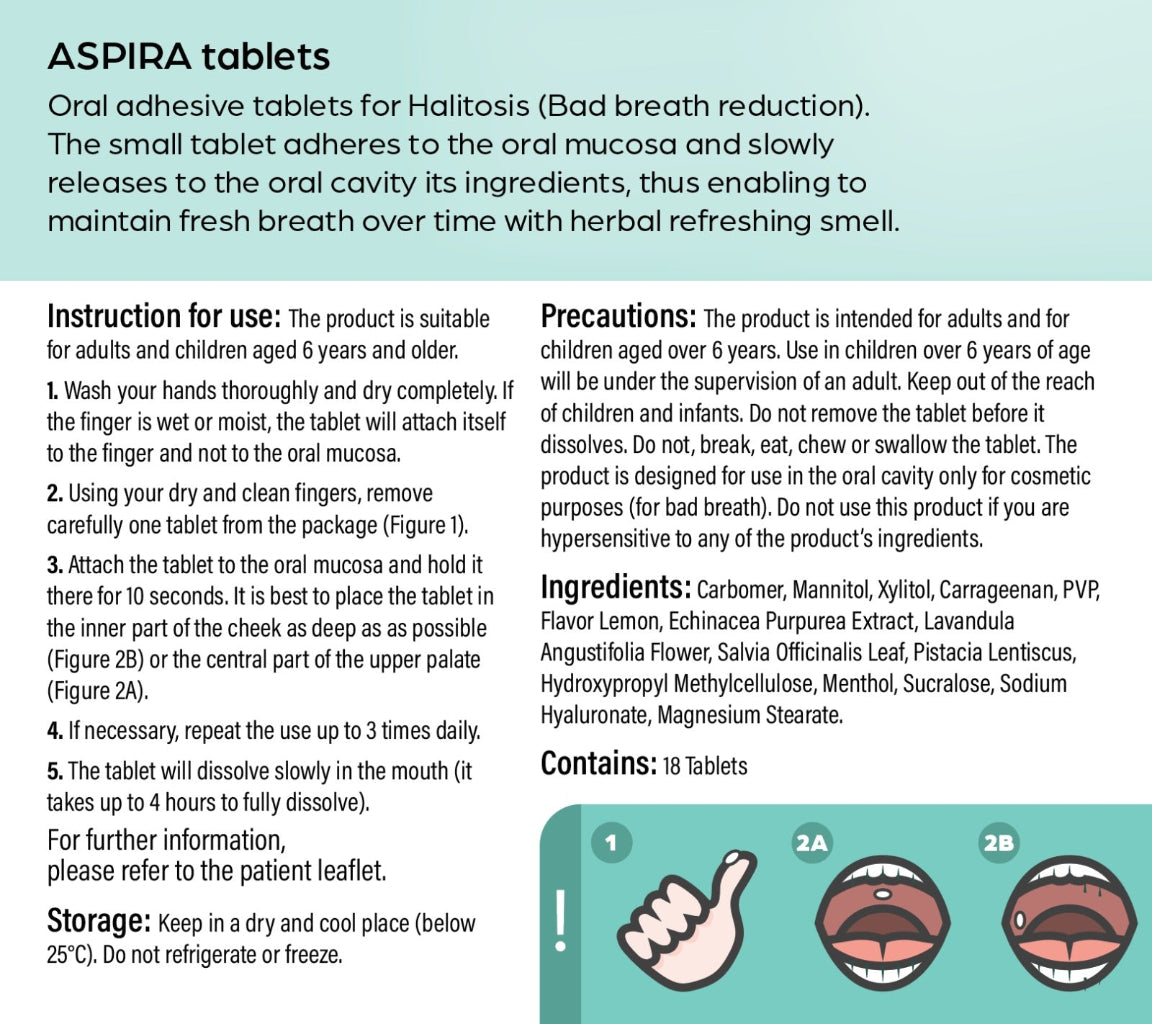
A mucoadhesive tablet sticks to the moist tissue inside the mouth and stays there. ASPIRA's tablet is placed against the inner cheek or the central part of the upper palate, held for about ten seconds, and then left alone. It dissolves gradually, releasing its ingredients into saliva over an extended period instead of all at once.
That is the whole design idea: duration rather than intensity. And it is the reason the main trial was built the way it was — measurements were taken the afternoon after use, not minutes after, because a few minutes would prove nothing that a mint can't.
What did the published research find?

Two human studies of this formulation have been published in peer-reviewed journals.
| Study | Design | People | Result vs. placebo tablet |
|---|---|---|---|
| Journal of Breath Research, 2013 | Randomized controlled trial: herbal tablet, placebo tablet, or a commercial mouthwash. Used in the evening and the next morning; measured the following afternoon. | 40 | Odor judge scores significantly lower (p = 0.004); volatile sulfur compounds significantly lower (p = 0.002); salivary β-galactosidase activity significantly lower (p = 0.02) |
| Journal of Dentistry, 2008 | The same tablet format prepared with different ingredients — the herbal formulation, zinc, chlorhexidine, or nothing at all | 56 | Odor judge scores significantly lower (p < 0.001); volatile sulfur compounds significantly lower (p = 0.013) |
Three things were measured each time: how two trained assessors rated the breath, an objective reading of volatile sulfur compounds from a sulfide monitor, and a salivary enzyme marker of the bacterial activity that produces odor. Using all three together is the standard approach in this field, because human perception is what matters in the end but is also subjective.
The 2008 study is the one that isolates the ingredients from the format. The placebo tablet had the same mucoadhesive design and no botanicals, and it did not produce the same result — so the effect is not simply the result of having something in your mouth.


How were the four botanicals chosen?
By testing them. A 2006 laboratory study published in Quintessence International screened nine plant extracts — echinacea, propolis, elder, mastic gum, marigold, sage, lavender, thyme and chamomile — in a saliva model, to see which ones reduced odor production. All produced some reduction; echinacea and lavender were the most effective. The four-plant combination came out of that screening and was then tested as a finished tablet in people.
How does ASPIRA compare with mints, gum and mouthwash?
| How it works | How long it stays in the mouth | |
|---|---|---|
| Mints | Flavor covers odor | Until the mint dissolves |
| Chewing gum | Flavor, plus saliva flow while chewing | While you chew |
| Mouthwash | Rinses the mouth | Spat out within a minute |
| ASPIRA | Adheres to the mucosa and releases its ingredients gradually | Until the tablet fully dissolves |
What the research does not show
Worth being straight about this, since the category is full of overstatement.
- The studies measured breath odor and the gases behind it. They do not establish anything about treating or preventing any condition, and ASPIRA makes no such claim.
- They were short-term. They don't establish results over weeks or months.
- Participants were healthy young adults. Bad breath arising from a medical or dental problem is a different question.
- Sample sizes were 40 and 56 — normal for this field, but not large trials.
ASPIRA is a cosmetic product for fresh breath. It is not a drug, not a dietary supplement and not a medical device, and it isn't a substitute for dental care. If your bad breath persists despite good oral hygiene, it's worth raising with a dentist — it can point to gum problems, dry mouth, or another cause worth treating properly.
The full breakdown of every study, including the methods and the exact citations, is on our clinical evidence page.
How do you use it?
With dry hands, take one tablet and press it against the inner cheek — as far back as is comfortable — or the central part of the upper palate, holding it for about ten seconds. Then leave it alone and let it dissolve; spit out what remains. It can be used up to three times a day, and it's intended for adults and children aged 12 and over.
Don't chew, break or force it off. If you want it out before it has dissolved, a little edible oil on a fingertip or a cotton swab, rubbed gently around the edges, will loosen it.
Frequently asked questions
How long does ASPIRA last?
The tablet stays in place until it has fully dissolved, which is considerably longer than a mint or a rinse. In the 2013 randomized controlled trial, participants used the tablet in the evening and the following morning, and the differences from placebo were still measurable that afternoon.
Does ASPIRA just cover up bad breath?
It isn't designed as a cover-up. Mints and gum work through flavor. In the published studies, the herbal formulation was compared against a placebo tablet of the same design, and the measured differences included volatile sulfur compound levels and a salivary enzyme marker — not just how the breath was rated.
What's in ASPIRA?
A patented formulation of Echinacea, Lavender, Mastic gum and Sage, in a slow-dissolving tablet base. The full ingredient list is: Carbomer, Mannitol, Xylitol, Carrageenan, PVP, Flavor, Potassium Carbonate, Hydroxypropyl Methylcellulose, Echinacea Purpurea, Lavandula Angustifolia, Salvia Officinalis, Pistacia Lentiscus (Mastic) Gum, Citrus Limon Fruit Oil, Magnesium Carbonate, Glucose, Menthol, Sodium Hyaluronate, Sucralose, Citral, Magnesium Stearate, Linalool, Geraniol.
Can you eat or drink with the tablet in?
The tablet is meant to be left in place to dissolve on its own, and it shouldn't be chewed, broken or eaten. Anything that dislodges it will cut short the slow release the product is built around.
Who shouldn't use it?
It's intended for adults and children aged 12 and over. Don't use it if you're hypersensitive to any of the ingredients listed above.
Part of our guide to the complete guide to VSCs and breath odor — where they come from, and what reduces them.