
Bad Breath Products Compared: What Actually Lasts
Lior HendlerBad Breath Products
Compared: What
Actually Lasts
Bad breath affects a large share of adults at some point, and most people reach for a mint, a stick of gum or a rinse of mouthwash. Those work — briefly. Understanding why they fade, and what changes when a product stays in your mouth for hours instead of minutes, is most of what you need to choose well.
First: why breath comes back after you've brushed
Most breath odor starts in the mouth, not the stomach. Bacteria on the back of the tongue and below the gumline break down proteins in saliva, and the by-products include volatile sulfur compounds — hydrogen sulfide, methyl mercaptan and dimethyl sulfide. Those gases are what people actually smell, and they can be measured directly with a sulfide monitor, which is why they're the standard objective endpoint in breath research.
Those bacteria repopulate within hours. That single fact explains almost everything about this category: a product that covers odor, or rinses the mouth once, stops working as soon as its own effect fades. Duration isn't a nice-to-have — it's the whole problem.
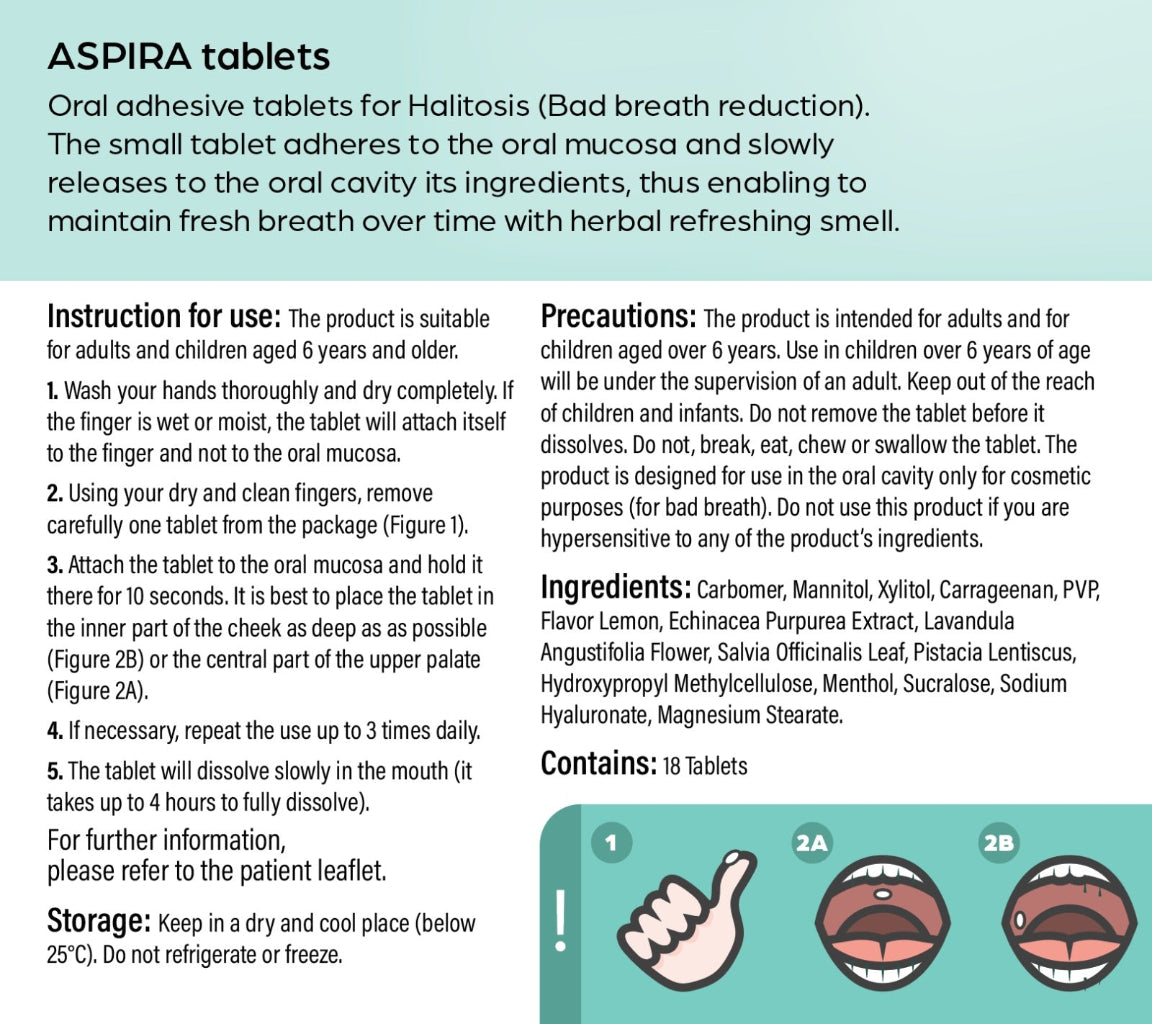
ASPIRA is a plant-based tablet that stays in place for hours instead of minutes.
The four approaches
Mints work by covering odor with a stronger smell. Sugar-free gum does a little more — chewing stimulates saliva, and saliva naturally clears some of the compounds behind odor. Both are genuinely useful in the moment.
Good for
- Immediate, socially quick fixes
- Cheap and available everywhere
- Sugar-free gum aids saliva flow
Limits
- Lasts about as long as the flavor
- Masks rather than reduces odor
- Needs constant reapplication
Mouthwash does real work while it's in contact with the mouth, and alcohol-free formulations are gentler on the oral tissue. The catch is structural: you spit it out. Once it's gone, so is its effect, and the bacteria return over the following hours.
Good for
- Part of a solid daily routine
- Reaches areas brushing misses
- Inexpensive, widely available
Limits
- Rinsed out within about a minute
- Needs a sink — impractical during the day
- Some formulas cause dryness, which can worsen odor
Brushing and cleaning the tongue is the foundation, and nothing else in this list replaces it. If your breath is a persistent problem, this is the first thing to get right — along with a dental check-up, since ongoing bad breath can point to gum disease or dry mouth that needs treating properly.
Good for
- Removes the bacterial film directly
- Tongue cleaning targets the main source
- Essential regardless of what else you use
Limits
- Effect fades over the following hours
- Not practical mid-day
- Doesn't cover the gap between brushings
A mucoadhesive tablet is placed against the inner cheek or the roof of the mouth, where it sticks and dissolves slowly instead of being chewed or swallowed. ASPIRA's tablet contains a patented formulation of four botanicals — Echinacea, Lavender, Mastic gum and Sage — released gradually into saliva. It's protected under US patent 9,480,641 B2.
The reason this format exists is duration. Everything above clears the mouth in minutes; this stays until it has dissolved. That's also what the published research was designed to test — measurements were taken the following afternoon, not minutes after use.
Good for
- Stays in place for hours, not minutes
- Discreet — no chewing, spraying or sink
- Plant-based, sugar-free and alcohol-free
- The formulation has published trial data
Limits
- Costs more than a pack of mints
- Needs dry fingers to adhere properly
- Takes some getting used to
- Not a substitute for brushing or dental care
Side by side
| Approach | How it works | How long it stays in the mouth | Best for |
|---|---|---|---|
| Mints & gum | Flavor masking; gum also raises saliva flow | Until it dissolves or you stop chewing | An immediate fix before a conversation |
| Mouthwash | Rinses and treats surfaces while in contact | Spat out within about a minute | A daily routine at home |
| Toothpaste & brushing | Mechanically removes bacterial film | Contact during brushing | The foundation everything else builds on |
| Mucoadhesive tablet | Adheres to the mucosa, releases gradually | Until the tablet fully dissolves | Covering the long gap between brushings |
One tablet, placed once, working while you eat, drink and talk.
What the published research shows
The herbal formulation used in ASPIRA has been evaluated in peer-reviewed studies indexed in PubMed. We're not aware of another breath-freshening tablet whose formulation has been through a published randomized controlled trial.
The randomized controlled trial (2013)
Published in the Journal of Breath Research. Forty people were randomly assigned to the herbal mucoadhesive tablet, an identical placebo tablet, or a commercial mouthwash. They used their assigned product in the evening and again the next morning; measurements were taken the following afternoon. Against placebo, the herbal tablet significantly reduced odor scores rated by two trained assessors (p = 0.004), volatile sulfur compound levels (p = 0.002) and a salivary enzyme marker of the bacterial activity behind odor (p = 0.02).
The earlier tablet study (2008)
Published in the Journal of Dentistry, with 56 volunteers. The same tablet format was prepared with different ingredients — the herbal formulation, zinc, chlorhexidine, or nothing at all. The herbal version significantly reduced both odor scores (p < 0.001) and volatile sulfur compounds (p = 0.013). The placebo tablet did not, which is what shows the effect comes from the formulation rather than from simply having something in your mouth.
- These were not head-to-head superiority trials against specific commercial products, and we don't claim they were.
- They were short-term. They say nothing about results over weeks or months.
- Participants were healthy young adults. Breath problems caused by a medical or dental condition are a different question.
- Sample sizes were 40 and 56 — normal for this field, but not large trials.
- The outcome measured was breath odor. Nothing here supports a claim about treating or preventing any condition, and we make none.
Read the full evidence breakdown, including methods and the exact citations with DOIs and PubMed links.
So which should you actually use?
Honestly, it depends on the gap you're trying to close.
If you need something right now — you're about to walk into a meeting — a mint or gum is the correct answer, and nothing else on this page beats it for speed.
If your breath is persistently bad despite good hygiene, don't start with a product at all. See a dentist. Persistent halitosis can point to gum disease, dry mouth or a sinus issue, and no breath product substitutes for treating the cause.
If your routine is solid and you just need to cover the hours between brushing — the mid-morning, the post-lunch, the long afternoon — that's the specific gap a mucoadhesive tablet is built for, and it's the case where ASPIRA makes sense.
Shop ASPIRA Tablets → Read the evidence
Try ASPIRA Tablets
Patented four-plant formula · Published trial data · Discreet, plant-based, sugar-free
Shop ASPIRA →Subscriptions available · Cancel anytime
ASPIRA is a cosmetic oral-care product intended to freshen breath and reduce unpleasant oral odor. It is not a drug, not a dietary supplement and not a medical device, and it is not intended to diagnose, treat, cure or prevent any disease. This article is published by ASPIRA, which sells one of the products described. Persistent bad breath that does not improve with good oral hygiene should be assessed by a dentist.